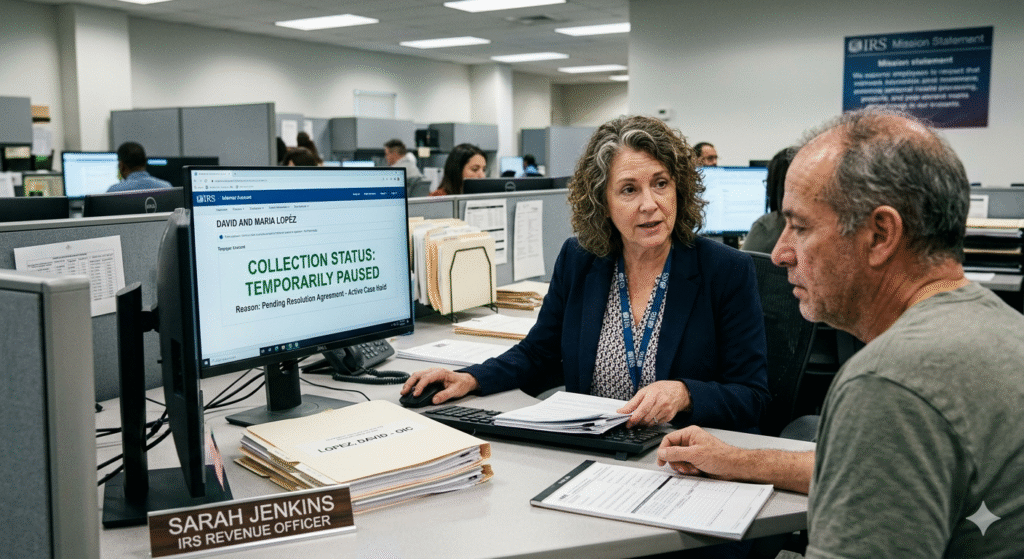
Many taxpayers believe that once they owe the IRS, collection actions are unavoidable – regardless of their financial situation. Others assume that the IRS will continue enforcement indefinitely, even when a taxpayer cannot meet basic living expenses. In reality, federal tax law and IRS administrative procedures recognize that some taxpayers simply do not have the ability to pay. In these cases, the IRS may place the account in Currently Not Collectible (CNC) status, temporarily suspending collection activity. CNC status does not eliminate the underlying tax debt, but it provides critical relief by halting enforcement actions such as levies and wage garnishments while the taxpayer’s financial condition remains constrained. For individuals, determining eligibility for CNC status is often an important step in protecting income and stabilizing finances during periods of hardship.
📘 Reference: Currently Not Collectible (CNC)
💡 Featured Snippet: What is Currently Not Collectible (CNC) status? Currently Not Collectible status is an IRS designation that temporarily stops collection actions when a taxpayer demonstrates they cannot afford to pay their tax debt due to financial hardship.
The Legal Authority Behind CNC Status
CNC status arises from the IRS’s authority to collect taxes under Internal Revenue Code §6331, which also permits the agency to delay or suspend collection when appropriate. The IRS uses administrative guidelines – primarily within the Internal Revenue Manual – to determine when collection would create undue hardship. Under these rules, the IRS evaluates whether collecting the tax would prevent the taxpayer from meeting necessary living expenses. Because CNC determinations involve detailed financial analysis, they are often reviewed with the assistance of a Washington, DC tax litigation attorney.
📘 Reference: IRC §6331
Why CNC Status Matters?
For taxpayers experiencing financial hardship, CNC status provides immediate and meaningful relief. When approved, CNC status can stop wage garnishments, prevent bank levies, pause active collection efforts, and provide time to stabilize finances. Although penalties and interest may continue to accrue, the suspension of enforcement actions can significantly reduce financial stress. For taxpayers facing IRS collection pressure, CNC status can serve as a critical safeguard.
What CNC Status Means for Taxpayers?
When a taxpayer is placed in CNC status:
📌 Collection Activity Is Suspended
The IRS will generally stop wage garnishments, bank levies, and active collection efforts.
📌 Interest and Penalties Continue
Although enforcement is paused, the balance may continue to grow over time.
📌 Ongoing Monitoring
The IRS may request updated financial information to assess whether the taxpayer’s situation has improved. CNC status is therefore temporary and subject to change based on financial circumstances.
Who Qualifies for CNC Status?
To qualify, taxpayers must demonstrate that paying their tax debt would create significant financial hardship. The IRS evaluates several factors:
- Income vs. Necessary Living Expenses: If income is only sufficient to cover essential expenses – such as housing, utilities, food, and medical care – the taxpayer may qualify.
- Assets and Equity: The IRS reviews whether assets could reasonably be used to satisfy the debt.
- Financial Documentation: Taxpayers must provide detailed documentation, including pay stubs, bank statements, expense records, and asset information.
For taxpayers, presenting accurate and well-documented financial information is essential to approval.
Benefits of CNC Status
There are benefits to a CNC status.
📌 Immediate Relief from Collections
CNC status stops active enforcement actions, providing immediate financial protection.
📌 Financial Breathing Room
Taxpayers can focus on meeting essential expenses without additional pressure from IRS collections.
📌 Time to Improve Financial Condition
The temporary nature of CNC status allows taxpayers to stabilize their finances before addressing the debt.
Limitations of CNC Status
While CNC status provides relief, it is important to understand its limitations:
- The tax debt is not forgiven.
- Interest and penalties continue to accrue.
- The IRS may review and remove CNC status if finances improve.
- A federal tax lien may still be filed in some cases.
Understanding these limitations is critical when evaluating whether CNC status is the appropriate solution.
What Happens After CNC Status Is Granted?
Once a CNC status is approved, collection actions are paused, the account remains open, and the IRS may periodically request updates. If the taxpayer’s financial situation improves, the IRS may resume collection efforts or recommend alternative resolution options.
Why Taxpayers Misunderstand CNC Status?
CNC status is often misunderstood because taxpayers believe it eliminates the debt, the temporary nature of the status is not always clear, IRS review procedures can be complex, and it is less widely known than other relief programs. As a result, some taxpayers overlook this option or misunderstand its purpose.
When to Seek Legal Guidance?
Taxpayers should consider consulting a Washington, DC tax attorney when IRS collection actions are ongoing, financial hardship is significant, documentation is complex, multiple resolution options are available, and CNC eligibility is unclear. Professional guidance can help ensure that financial information is presented accurately and that the most appropriate strategy is selected.
📘 Reference: IRS Form 2848, Power of Attorney
Need help with a similar issue? Contact our firm today for a consultation.
Currently Not Collectible status provides an important form of relief for taxpayers who cannot afford to pay their IRS debt. By temporarily suspending collection actions, CNC status allows individuals to focus on essential living expenses and financial recovery without the immediate threat of enforcement. However, because the relief is temporary and subject to review, it is important to approach CNC strategically and understand its limitations. Taxpayers facing financial hardship should evaluate their options early and take action to protect their financial stability.
Contact Pelham PLLC, a Washington, DC tax attorney firm, for confidential assistance with IRS collection relief and tax debt resolution.
FAQs
What is CNC status?
It is an IRS designation that temporarily stops collection actions due to financial hardship.
Does CNC status eliminate tax debt?
No, the debt remains, but collection is paused.
Will the IRS stop garnishing wages?
Yes, collection actions are generally suspended while in CNC status.
Can the IRS review my status later?
Yes, the IRS may reassess your financial condition periodically.
Do I need proof of hardship?
Yes, detailed financial documentation is required.
Do I need a Washington, DC tax attorney?
Legal guidance can help ensure proper documentation and improve approval chances.