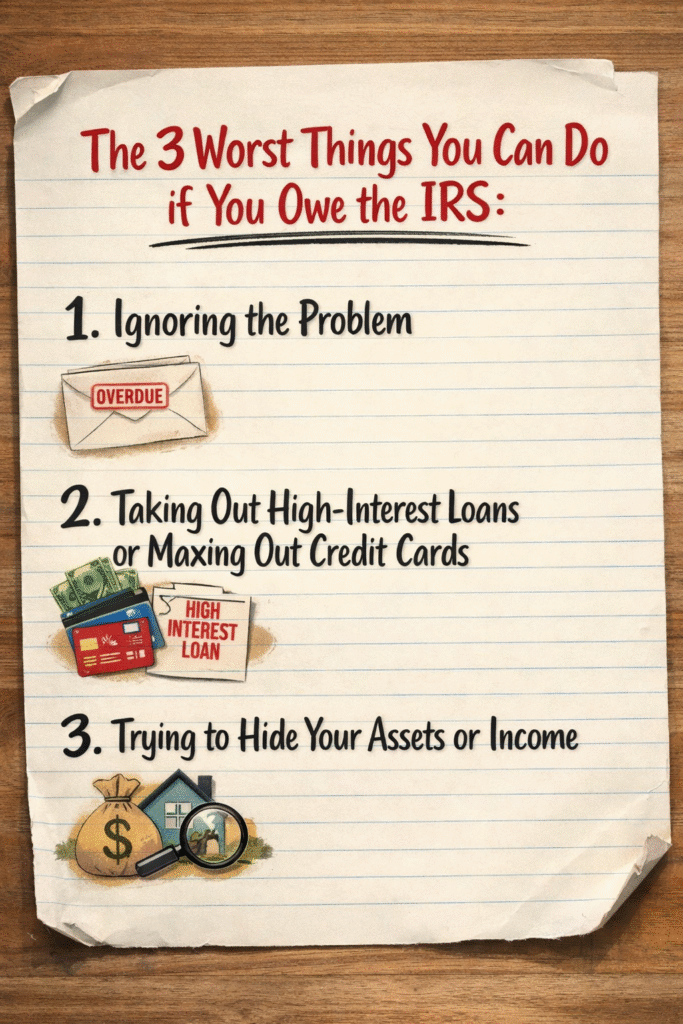
Many taxpayers assume that owing the IRS is simply a financial issue that can be addressed later when funds become available. Others believe that delaying action – or making quick decisions under pressure – will help them regain control of the situation. In reality, IRS tax debt is governed by strict enforcement procedures. When not addressed properly, it can escalate quickly through penalties, interest, and increasingly aggressive collection actions. The decisions taxpayers make early in the process often determine whether the situation remains manageable, or becomes significantly more complex and costly. For individuals and businesses, avoiding common worst IRS debt mistakes is one of the most important steps in protecting financial stability and preserving available resolution options.
📘 Reference:
💡Featured Snippet: What are the worst mistakes to avoid when you owe the IRS? The most serious mistakes include ignoring the debt, taking on high-interest loans to pay the IRS, and attempting to hide income or assets. These actions can lead to increased penalties, financial hardship, and potential legal consequences.
Mistake #1 – Ignoring the Problem
The most damaging mistake taxpayers make is failing to address IRS debt altogether. Many assume that avoiding IRS notices will delay consequences or that the issue may resolve itself over time. In reality, the IRS continues to assess penalties and interest, and enforcement actions will eventually follow.
❌ What Happens If You Ignore IRS Debt?
If you ignore the IRS debt, penalties and interest continue to accrue, the IRS notices escalate in urgency, collection actions may begin, and assets and income may be targeted. Ignoring the problem often results in a manageable tax issue becoming significantly more severe.
✔️ What to Do Instead?
Taxpayers should take action immediately, even if full payment is not possible. Options may include Installment Agreements, Offer in Compromise, and Currently Not Collectible status. Early engagement – often with guidance from a Washington, DC tax attorney – can significantly reduce overall liability and prevent enforcement.
Mistake #2 – Using High-Interest Debt to Pay the IRS
Another common mistake is attempting to resolve IRS debt by taking out high-interest loans or relying on credit cards. This approach is often driven by urgency, but it can create a more serious financial problem.
❌ Why This Strategy Fails?
This strategy fails because:
- Credit card and payday loan interest rates are often significantly higher than IRS interest rates.
- Debt shifts from a structured IRS system to unsecured high-interest obligations.
- Financial strain increases without reducing underlying risk.
In many cases, taxpayers end up with greater overall debt and fewer options for relief.
✔️ What to Do Instead?
Rather than taking on high-interest debt, taxpayers should explore IRS-administered solutions, such as installment agreements with lower interest rates, temporary hardship relief, or negotiated settlements. A Washington, DC tax attorney can help evaluate which option best aligns with the taxpayer’s financial situation.
Mistake #3 – Hiding Income or Assets
Some taxpayers attempt to avoid IRS collection by concealing income, transferring assets, or failing to file returns. This is one of the most serious mistakes a taxpayer can make.
❌ Risks of Concealment
The IRS has extensive access to financial data, including bank records and third-party reporting. Undisclosed income may be detected through automated systems. Penalties can increase significantly, and criminal exposure may arise in cases of intentional evasion. Attempting to hide assets or income can transform a civil tax issue into a legal matter with far more severe consequences.
✔️ What to Do Instead?
Transparency is essential when dealing with the IRS. Taxpayers should accurately report income, provide complete financial disclosures, and work within established IRS resolution programs. Options such as Offer in Compromise or Currently Not Collectible status are designed to address inability to pay without the risks associated with concealment.
When to Seek Legal Guidance?
Taxpayers should consider consulting a Washington, DC tax attorney when:
- IRS notices are escalating.
- Payment in full is not possible.
- Collection actions are threatened or underway.
- Significant tax debt is involved.
- Multiple years of liability exist.
Professional guidance can help avoid costly mistakes and improve outcomes.
📘 Reference: IRS Form 2848, Power of Attorney
Need help with a similar issue? Contact our firm today for a consultation.
Owing the IRS can be stressful, but the situation becomes significantly more difficult when taxpayers make avoidable mistakes. Ignoring the problem, taking on high-interest debt, or attempting to conceal financial information can all lead to increased penalties and aggressive enforcement actions. Understanding what not to do – and taking proactive steps instead – can make the difference between a manageable resolution and a prolonged financial burden. Taxpayers who act early and strategically are far more likely to achieve favorable outcomes.
Contact Pelham PLLC, a Washington, DC tax attorney firm, for confidential assistance with IRS tax debt and collection issues.
FAQs
What is the worst thing to do if you owe the IRS?
Ignoring the debt is the most damaging mistake, as penalties and enforcement actions will increase over time.
Should I use a credit card to pay the IRS?
Generally no, as high-interest debt can create greater financial problems.
Can I hide income from the IRS?
No, doing so can lead to severe penalties and potential criminal consequences.
What happens if I don’t respond to IRS notices?
The IRS may escalate to levies, liens, and other enforcement actions.
What should I do if I can’t pay my taxes?
Explore IRS programs such as payment plans or settlement options.
Do I need a Washington, DC tax attorney?
Legal guidance can help you avoid mistakes and resolve tax debt effectively.